How to analyze traffic?
The basics of analyzing your funnel in 3 minutes.
No orders, or they're too expensive... Why? This question can stump even an experienced marketer. We've prepared a short guide that will help you properly analyze and test an offer with a minimal budget. Your task is to simplify the customer's path, make the offer attractive, and optimize and diversify all the technical aspects.
Step 1: Choosing an offer
Choose products used by a medium or large number of potential customers.
Prefer small products to cut delivery and warehouse costs — this rule works in affiliate programs too.
Rely on your own expertise and the product's seasonality.
Analyze competitors and test alternative products. We don't recommend copying competitors' products.
Step 2: Creating the site
Make sure the landing page loads fast (under 3 sec).
Use calls to action (gifts, discounts, reviews…).
Set the lowest selling price for the time of the test.
The first screens should immediately show the need and the benefit of buying.
Order elements should be convenient, visible and, most importantly, working.
You can also add unobtrusive pop-ups, Call-Back buttons and a mask in the phone number field.
Step 3: Creating the ad
The ad should answer the questions: “What is it?” and “What problem does the product solve?”.
Put key information at the top of the ad.
We recommend using numbers in the ad and the same color scheme as the site, and avoiding repeated words / complex sentences.
Always add a call to action (limited offer, promotion period, super price…).
Avoid clickbait (text that makes people click but doesn't lead to buying the product).
Try to fill in 50+% of the maximum number of assets in the ad to give the platform's algorithms material for promotion.
Step 4: Launch and diversification
Use accounts of different origin to rule out bad ad accounts as a factor.
Split the traffic: 2–3 campaigns in each ad account, 3+ ad accounts and, ideally, several traffic sources (Google, Facebook). Testing this way gives clearer results.
Setup details differ between sources, but a narrower target audience always means more expensive traffic. Try to keep audience settings to a minimum.
Don't spend the whole budget if you haven't had a single order after the first 300–500 clicks — look for and fix what is most likely a technical problem.
Don't interfere with ad campaign optimization until you've collected enough data for it.
How much to spend on a test?
Up to $100 per ad source is enough for a full test.
Example: 2 sources × 3 ad accounts × 3 campaigns × 2 days × $5 a day = $180 (±$90 per traffic source).
Analyzing the traffic
⚠️ This is the most important stage. You can see how the main metrics relate to each other, and the actions at each stage, in the diagram below.
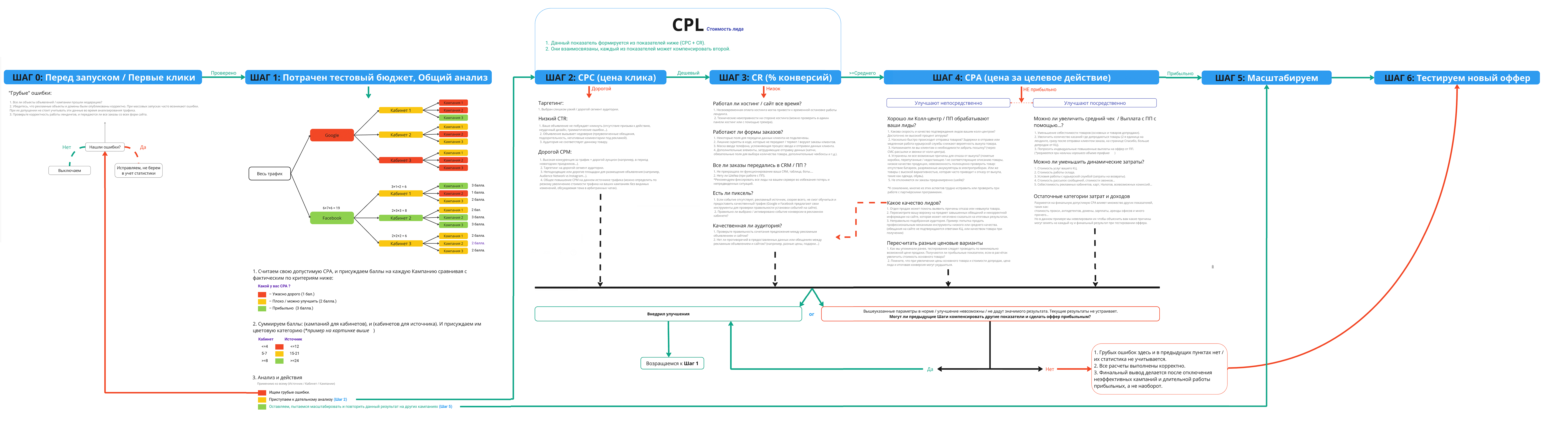
❗️This example of actions was made to be clear and easy to understand even for beginner marketers. In practice, the structure, launch conditions and factors affecting your results are far more varied. In this example we've gathered the key points to help you see whether something can be improved.
What else to keep in mind?
Ad source updates: sudden changes can worsen the cost and conversion rate of your traffic. In this case it's better to lower budgets for a while.
Call center quality: how well orders are processed, confirmed and delivered affects your profit. Compare several partners to choose the best one.
Ad account quality: always have alternatives to avoid supply problems.
The complexity / absurdity of traffic setup: working with traffic, we've seen orders disappear for no visible reason. The fixes sometimes seemed absurd: changing the Fan Page, creating a new pixel in the ad account, using other payment methods or changing the order of steps when launching ad campaigns really did bring traffic back to normal. But such hypotheses are worth testing only after you've analyzed everything else on this list.
If nothing worked
Check that all the recommendations (Steps 1–4) are followed.
Make sure the results you analyzed are correct (see the diagram above).
If the market hasn't confirmed demand for your product, try testing a new one.
If you've tested many offers but haven't got the result you want, it's time to dig into the problem in more detail, as mentioned above (“What else to keep in mind”, item 4).
Recommendations and conclusions
We've tried to explain the basics of finding offers, preparing them, testing and analyzing traffic as simply as possible. Of course, this guide doesn't cover every possible detail, since this field is full of nuances that can take months or even years to study and describe.
The market keeps changing — keep learning, experimenting and adapting along with it, and success won't keep you waiting.